Enforcer
Barrier and guardian kit that shields allies and holds the push — the suit that lets an under-geared front survive a focus. Highest priority pick in organized war.
War role: hold the lineRF Online Next · Endgame PvP
How the large-scale Holy Stone war actually works — the 450-player faction fight, Sacred Weapon (MAU / Launcher / Animus) tactics, the biosuits that matter in mass PvP, and where each faction wins.

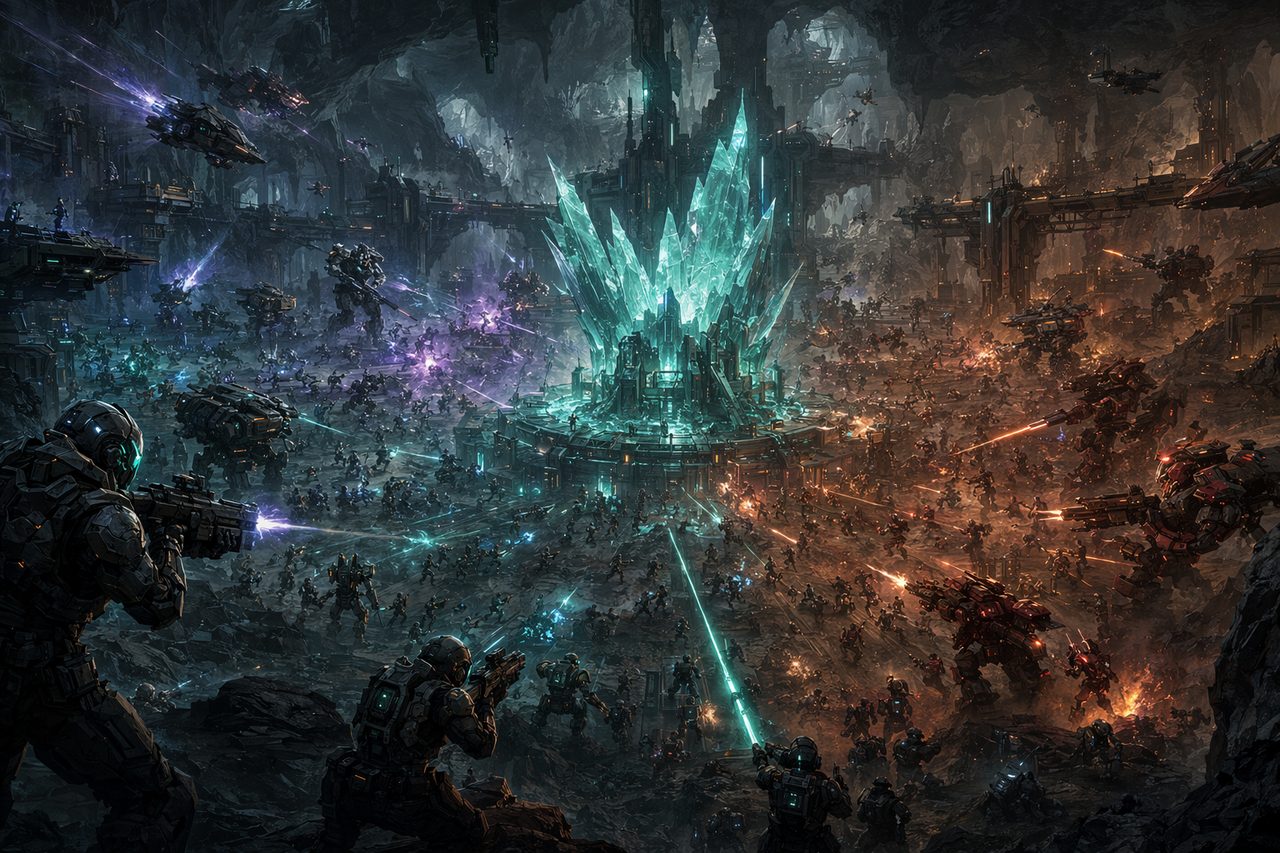
RF Online Next keeps the franchise's defining identity: a three-faction war over scarce resources on the planet Novus. The original RF Online was nicknamed "Miner Online" because the Holy Stone Mine — and the Control Chip that governs it — was the heart of every server. The sequel scales that up into the Mining War.
Factions contest the mining nodes that produce the server's core resources. Holding them feeds your faction's economy and starves your rivals.
Large-scale, three-sided combat across ground and air. Coordination, not raw individual power, decides who holds the field.
The winning faction reaps resources and economic advantage that compound into stronger characters — so the war never really ends.
Verified mechanics: three factions, Holy Stone resource control, large-scale (up to 450-player) ground-and-air combat. Exact node timers, scoring, and reset cadence vary by patch — confirm in-game for your current server.
Sacred Weapons are the mech-tier assets that swing large engagements. Each fills a different battlefield job — the skill is in timing them, not just owning them.
A Mechanic Armor Unit you board and pilot directly — a mobile damage-and-pressure platform for charging lines and crushing chokepoints. Strong when escorted; vulnerable on its dismount window.
A deployed weapon that auto-detects and engages enemies — area denial that locks down a node or a corridor. Place it where your frontline can protect it.
A summoned bio-weapon that unleashes one devastating, game-changing skill and then vanishes. A finisher — hold it for a decisive teamfight or to break a stalled push.
Verified: MAU is piloted, Launcher auto-targets, Animus is a one-shot summon. Specific cooldowns, charge costs, and damage values are confirm in-game at the current patch.
Because biosuits swap mid-combat and skill levels carry across them, the right question for war is "what role does my faction need on the field?" — not "what's the best 1v1 suit?" The shortlist below is organized by war role, the way a raid leader actually fills a roster. Use the filter to find the job you need to cover.
Barrier and guardian kit that shields allies and holds the push — the suit that lets an under-geared front survive a focus. Highest priority pick in organized war.
War role: hold the lineHigh-HP disruptor with gap-closers built to shatter enemy lines and create the opening your damage follows through.
War role: break formationHealing fields, drones, and deployables that keep a 40-player push alive far longer than it should be. Force-multiplies every other suit on the field.
War role: keep them standingLong-range area damage that punishes grouped enemies clustering on a mining node — the clearest "zone the objective" tool in the roster.
War role: control the nodeReliable ranged physical pressure with stuns — safe, consistent contribution from the backline without the fragility of a pure burst pick.
War role: steady pressureHigh-mobility assassin built to delete priority targets — enemy support and artillery — before they can act. Rewards skill; punishes overextension.
War role: kill the backlineHybrid melee with self-sustain — dives the backline but lives long enough to get out, making it more forgiving than a glass-cannon assassin.
War role: sustained diveForce-magic AoE and control fields — area damage plus disruption that slows an enemy advance onto a contested node.
War role: zone & disruptProvisional This shortlist ranks biosuits by role fit in large-scale war using each suit's verified kit. It is not a competitive S/A/B duel ranking — the launch meta is days old and shifts with every balance patch. Treat it as a roster-building framework and confirm the current patch in-game.
All three factions can win the Mining War; they get there with different identities. Pick the one whose war style you actually enjoy — you will be living in it.
| Faction | War identity | Best for the player who… |
|---|---|---|
| Bellato Union | Technology and mechs — leans into Sacred Weapon and gear-driven warfare. | …likes coordinated, equipment-forward pushes. |
| Holy Alliance of Cora | Force and summons — magic-leaning pressure and disruption. | …wants range, control, and zoning tools. |
| Accretian Empire | Pure machine — durable, aggressive, frontline-forward identity. | …wants to be at the tip of the spear. |
Faction identities follow the franchise's long-standing design. Current-patch faction balance and population on your server are confirm in-game — population often matters more than any roster on paper.
Most RF Online Next guides hand you a tier list with no sourcing. We do it the other way around, because the game is days old and honesty is the only durable edge.
| Claim type | Confidence | Basis |
|---|---|---|
| War mechanics (factions, Holy Stone, 450-player scale) | High | Official launch material + franchise history |
| Sacred Weapon roles (MAU / Launcher / Animus) | High | Official feature descriptions |
| Biosuit kit and role identity | Medium | Official suit descriptions + early community play |
| Competitive S/A/B war rankings, numbers, cooldowns | Provisional | Launch meta unsettled — verify in-game |
If you spot a current-patch detail that contradicts the above, that means the meta moved — and we'd rather say so than pretend otherwise.
Both. "Mining War" is Netmarble's official name for the large-scale faction battle; "Chip War" is the long-running community term from the original RF Online, where factions fought over the Control Chip in the Holy Stone Mine. They mean the same large-scale resource war.
Mining Wars are built for large-scale combat of up to 450 players across the three factions contesting Holy Stone resources.
They are not interchangeable. The MAU is your piloted pressure platform, the Launcher locks down a node or corridor, and the Animus is a one-shot finisher you hold for a decisive teamfight. "Best" depends on the job you need filled at that moment.
Bring the role your guild lacks: a frontline anchor (Enforcer / Dreadnought), sustain (Technician), node artillery (Demolisher / Punisher / Psypher), or a burst pick (Phantom / Arbiter). Since biosuits swap mid-combat, build toward covering a gap rather than chasing the strongest duelist.